
Best Yamaha Keyboards 2025: Top 5 Picks for Beginners to Pros
Explore the best Yamaha keyboards in 2025, from beginner-friendly models to professional-grade digital pianos. Compare features, sound quality, and value to find your perfect match.

| 5 Best Yamaha Keyboards in 2025 The Complete Buyer’s Guide — From Beginner to Professional Digital Choice Hub | digitalchoicehub.com | Updated 2025 |
| ⚡ Quick Answer: The best Yamaha keyboard overall is the Yamaha P-515 — offering concert-grand realism, natural wood action, and 256-note polyphony in a portable form. For beginners, the PSR-E473 delivers outstanding value. The DGX-670 is the top pick for versatility. Power performers choose the PSR-SX900. Serious pianists invest in the Clavinova CLP-745. |
Bestseller #1
Bestseller #3

At a Glance: Top 5 Yamaha Keyboards
| # | Model | Best For | Price (Approx.) | Rating |
| 1 | Yamaha P-515 | Serious pianists, home/stage | $1,999 | ★★★★★ 4.9 |
| 2 | Yamaha DGX-670 | Versatile all-rounders | $799 | ★★★★★ 4.7 |
| 3 | Yamaha PSR-SX900 | Live performers & producers | $2,299 | ★★★★★ 4.8 |
| 4 | Yamaha PSR-E473 | Beginners & budget players | $369 | ★★★★☆ 4.4 |
| 5 | Yamaha Clavinova CLP-745 | Advanced pianists at home | $3,499 | ★★★★★ 4.9 |
Why Yamaha Keyboards Dominate the Market
Yamaha has been building instruments since 1887, and its digital keyboard lineup is the result of over a century of acoustic and electronic expertise. Whether you are a curious beginner picking up your first instrument, an intermediate player wanting to grow, or a touring professional who needs stage-ready reliability, Yamaha offers a keyboard tuned to your exact situation.
This guide cuts through the noise. We cover the five best-selling, highest-rated Yamaha keyboards available today, explain exactly what each one does well, and — critically — tell you which one is right for you. Scroll to the section that matches your skill level, or read in order for the full picture.
Who Should Read This Guide?
| You Are… | The Right Yamaha Keyboard |
| A complete beginner (never played before) | PSR-E473 |
| A student who practices at home | DGX-670 or Clavinova CLP-745 |
| An intermediate player wanting realistic piano feel | P-515 |
| A gigging musician or live performer | PSR-SX900 |
| A serious pianist or conservatory student | Clavinova CLP-745 |
| A songwriter needing arranger features | DGX-670 or PSR-SX900 |
| A church or worship musician | PSR-SX900 or DGX-670 |
| #1 Yamaha P-515 Best Overall — Concert-Grand Feel in a Portable Body |
The Yamaha P-515 is the pinnacle of the P Series and one of the finest portable digital pianos ever built. It combines the sound of two legendary concert grand pianos — the Yamaha CFX and the Bösendorfer Imperial — into an instrument that weighs just 16.5 kg yet produces an extraordinary acoustic performance.
Key Specifications
| Spec | Detail |
| Keys | 88 — Natural Wood Graded Hammer (NW-GH) with escapement & ivory/ebony feel |
| Polyphony | 256 notes |
| Sound Engine | CFX + Bösendorfer Imperial stereo sampling with Binaural Sampling |
| Voices | 36 internal voices |
| Connectivity | USB to Host/Device, Bluetooth MIDI & Audio, L/R balanced outputs |
| Speaker System | 4-speaker system, 2 x 15W + 2 x 20W (70W total) |
| Weight | 16.5 kg / 36.4 lbs |
| Approx. Price | $1,999 USD |
What Makes the P-515 Outstanding
The NW-GH action uses real wood in the key construction, giving each keystroke genuine resistance and tactile feedback that synthetic keys simply cannot replicate. The escapement mechanism — a clicking sensation found on acoustic grand piano keys — is reproduced faithfully, allowing rapid repeated notes (trills, fast runs) with concert-hall precision.
Virtual Resonance Modeling (VRM) simulates the sympathetic resonance between strings that you hear when the sustain pedal is depressed on a real piano. This makes the P-515 one of the most sonically accurate digital pianos under $3,000. Binaural Sampling, when used with headphones, projects the sound three-dimensionally — as if the piano is physically in the room around you.
The Piano Room feature lets you dial in the room acoustics: concert hall, studio, living room, chamber, or cathedral. Combined with the dual-grand-piano sampling, this transforms the P-515 from a practice tool into an expressive performance instrument.
Best Uses
- Serious home practice for intermediate to advanced pianists
- Stage performance (slim, portable, professional output)
- Teaching studios needing a high-quality reference instrument
- Conservatory prep and classical repertoire
- Recording direct into a DAW via USB audio
Pros & Cons
| PROS | CONS |
| ✔ Dual CFX + Bösendorfer sampling is unmatched at this price | ✘ Only 36 internal voices — not an arranger keyboard |
| ✔ Natural wood escapement action feels like a grand piano | ✘ Requires external stand (sold separately) |
| ✔ 256-note polyphony — no note cutoff during complex passages | ✘ No built-in accompaniment styles |
| ✔ Bluetooth MIDI & audio — connects wirelessly to apps | ✘ Headphone output shared with line out |
| ✔ Slim, clean design — fits any room aesthetics |
Ratings Breakdown
Sound Quality ★★★★★ 5.0/5
Key Action ★★★★★ 5.0/5
Connectivity ★★★★★ 4.5/5
Value for Money ★★★★★ 4.5/5
Portability ★★★★☆ 4.0/5
OVERALL ★★★★★ 4.9/5
| #2 Yamaha DGX-670 Best All-Rounder — The Portable Grand for Every Player |
Yamaha calls the DGX-670 the “Portable Grand” — and it earns that title. It bridges the gap between a full-featured arranger keyboard and a professional-quality digital piano. With GHS weighted action, CFX Stereo Grand Sampling, and hundreds of voices and accompaniment styles, it suits students, hobby players, gigging musicians, and home recording enthusiasts equally well.
Key Specifications
| Spec | Detail |
| Keys | 88 — GHS (Graded Hammer Standard) weighted action |
| Polyphony | 192 notes |
| Sound Engine | CFX Stereo Sampling + VRM + Binaural Sampling (headphones) |
| Voices | 630 internal voices + 10 drum/SFX kits |
| Styles | 235 auto-accompaniment styles |
| Connectivity | USB to Host/Device, Bluetooth Audio & MIDI, microphone input |
| Speaker System | 2 x 10W built-in amplifiers |
| Approx. Price | $799 USD |
What Makes the DGX-670 Outstanding
The DGX-670 gives you CFX Grand Piano sampling — the same technology found in Yamaha’s premium models — at roughly one-third the cost of the P-515. The GHS action provides progressively heavier key resistance from high to low notes, accurately mimicking an acoustic piano’s response and building the correct muscle memory for piano technique.
Where the DGX-670 separates itself from the P-515 is in its arranger capabilities. With 630 voices spanning orchestral instruments, synthesizers, guitars, organs, and world instruments, and 235 accompaniment styles ranging from jazz to electronic dance music, it functions as a complete band-in-a-box. The built-in microphone input with vocal harmony effects makes it ideal for singer-songwriters.
Bluetooth audio streaming means you can play along to tracks from your phone wirelessly, while Bluetooth MIDI connects seamlessly to apps like flowkey for guided lessons. The Piano Room and Intelligent Acoustic Control (IAC) automatically optimize the sound balance at any volume level.
Best Uses
- Intermediate players who want both piano and arranger features
- Singer-songwriters and home music producers
- Students learning piano with structured app-based lessons
- Church, small venue, and cafe performances
- Families wanting one keyboard that everyone can enjoy
Pros & Cons
| PROS | CONS |
| ✔ Best value per feature in the Yamaha lineup | ✘ GHS action less realistic than P-515’s NW-GH |
| ✔ CFX sampling sounds exceptional for the price | ✘ Only 192 polyphony (vs. 256 on P-515) |
| ✔ 630 voices — vast creative palette | ✘ Built-in speakers are modest (20W total) |
| ✔ Built-in mic input with vocal harmony effects | ✘ Design is bulkier than the P-Series |
| ✔ Bluetooth audio & MIDI for wireless connectivity | ✘ Headphone and line-out jack are shared |
Ratings Breakdown
Sound Quality ★★★★★ 4.7/5
Key Action ★★★★☆ 4.4/5
Feature Set ★★★★★ 5.0/5
Value for Money ★★★★★ 5.0/5
Portability ★★★★☆ 4.0/5
OVERALL ★★★★★ 4.7/5
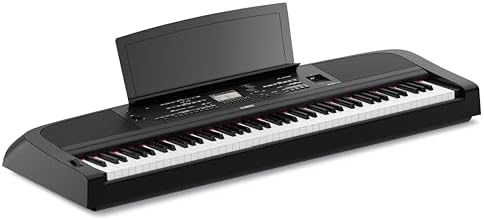
- Acoustic Piano Touch: Weighted keyboard action is heavier in the low keys and lighter in the high keys – perfect for pra…
- Grand Piano Sound: CFX Stereo Sampling faithfully reproduces the sound of Yamaha’s flagship CFX Full Concert Grand – com…
- Variety of Instrument Sounds: Features 630 instrument Voices, including pianos, organs, strings, and synthesized sounds
$749.99
| #3 Yamaha PSR-SX900 Best for Live Performers — Pro Arranger Workstation |
The PSR-SX900 is Yamaha’s flagship mid-range arranger workstation — a stage-ready powerhouse used by solo performers, worship bands, cover bands, and professional composers worldwide. It replaced the hugely popular PSR-S series and brought with it expanded audio styles, Genos-derived sounds, and a completely redesigned user interface.
Key Specifications
| Spec | Detail |
| Keys | 61 — Touch-sensitive, unweighted (semi-concert format) |
| Polyphony | 128 notes |
| Sound Engine | AWM2 Stereo Sampling — 1,272 voices + 58 drum/SFX kits |
| Styles | 500 built-in accompaniment styles + Audio Styles |
| Display | 7-inch color touchscreen |
| Connectivity | USB to Host/Device, AUX In/Out, MIDI In/Out, microphone input |
| Speaker System | Woofer + 3-way speaker system, 15W + 15W + 6W x 2 (42W total) |
| Approx. Price | $2,299 USD |
What Makes the PSR-SX900 Outstanding
The PSR-SX900’s standout feature is its Audio Styles system — accompaniment tracks that use actual recorded audio loops rather than MIDI samples, producing a richness and realism that traditional MIDI-based styles cannot match. Over 500 built-in styles span virtually every musical genre on earth, from Viennese waltz to Afrobeat, country shuffle to modern EDM.
The 7-inch color touchscreen makes navigation fast and intuitive during live performance. Registrations allow you to save and recall complete setups — voice, style, tempo, effects — with a single button press, making set changes between songs seamless. The keyboard also supports expansion packs from Yamaha’s library, letting you load additional custom voices and styles.
The 1,272-voice library includes Super Articulation 2 voices — the highest grade of Yamaha’s expressive voice technology — which dynamically simulate the specific playing techniques of instruments: guitar hammer-ons, saxophone key noise, violin bow changes, and more.
Best Uses
- Solo performers playing full-band arrangements live
- Worship musicians needing versatile one-keyboard setups
- Songwriters and composers building full arrangements
- Cover bands and entertainment keyboard players
- Music producers exploring global and orchestral sounds
Pros & Cons
| PROS | CONS |
| ✔ 1,272 voices with Super Articulation 2 — deeply expressive | ✘ Unweighted keys — not suitable for developing classical piano technique |
| ✔ Audio Styles produce genuine band-quality backing tracks | ✘ High price point for a 61-key keyboard |
| ✔ 500+ styles covering virtually every musical genre | ✘ Learning curve is steep for casual players |
| ✔ 7-inch color touchscreen for fast live navigation | ✘ Large and heavy for transport compared to P-Series |
| ✔ Powerful speaker system with a dedicated woofer | ✘ No Bluetooth audio (MIDI only via USB) |
Ratings Breakdown
Sound Library ★★★★★ 5.0/5
Live Performance ★★★★★ 5.0/5
Key Action (piano feel) ★★★★☆ 3.5/5
Value for Money ★★★★★ 4.5/5
Ease of Use ★★★★☆ 4.0/5
OVERALL ★★★★★ 4.8/5
| #4 Yamaha PSR-E473 Best for Beginners — Big Features, Small Price |
The PSR-E473 is the entry point into Yamaha’s impressive lineup, and it massively over-delivers for its price. Featuring 820 voices, a newly developed tone generator, dual DSP channels, and a real microphone input, it outperforms what most players would expect from an entry-level keyboard. This is the keyboard that gets beginners hooked.
Key Specifications
| Spec | Detail |
| Keys | 61 — Touch-sensitive, unweighted synth action (4-level velocity) |
| Polyphony | 64 notes |
| Sound Engine | AWM Stereo Sampling — 820 voices + 10 drum/SFX kits |
| Styles | 290 auto-accompaniment styles |
| Effects | Dual DSP channels, Reverb, Chorus, Motion Effect, Mega Boost (+6dB) |
| Connectivity | USB to Host/Device, L/R audio output, 1/4-inch mic input |
| Speaker System | 2 x 6W built-in stereo speakers |
| Approx. Price | $369 USD |
What Makes the PSR-E473 Outstanding
Yamaha’s redesigned tone generator for the PSR-E473 delivers sound quality that punches well above its price bracket. The main Concert Grand piano voice draws from Yamaha’s professional sampling library, and the 64-note polyphony — double that of many competing entry-level keyboards — ensures clean, uncluttered sound when playing chords and accompaniment simultaneously.
Super Articulation Lite voices add expressive realism to specific instruments: you hear the pick scratch on a distorted guitar, the breathy attack of a flute, or the harmonics of a nylon-string classical guitar. Two assignable Live Control Knobs allow real-time manipulation of brightness, filter, effects, and modulation — giving performers genuine expressive control.
The built-in microphone input with vocal effects transforms the PSR-E473 into a complete performance station. The Mega Boost button adds 6dB of output volume, letting the keyboard be heard above other instruments even without a PA. The USB-to-Host port enables direct connection to computers for recording and lesson apps like flowkey.
Best Uses
- First keyboard for children and adult beginners
- Students learning with app-based platforms (flowkey, Simply Piano)
- Casual home players wanting diverse sounds and entertainment
- Singer-songwriters on a tight budget
- Musicians who need a lightweight, battery-powered practice keyboard
Pros & Cons
| PROS | CONS |
| ✔ Exceptional value — professional-grade voices at entry price | ✘ Keys are unweighted — not ideal for classical piano technique |
| ✔ 820 voices covering pianos, organs, synths, world sounds | ✘ 64-note polyphony can be limiting in complex arrangements |
| ✔ Real microphone input with vocal effects — rare at this price | ✘ Speaker output (12W) modest for large rooms |
| ✔ Super Articulation Lite for expressive instrument realism | ✘ No Bluetooth |
| ✔ Lightweight and battery-operable (6 AA batteries) | ✘ Keys may feel less premium over time with heavy use |
Ratings Breakdown
Sound Quality ★★★★★ 4.5/5
Value for Money ★★★★★ 5.0/5
Feature Set ★★★★★ 4.5/5
Portability ★★★★★ 5.0/5
Key Action (for beginners) ★★★★☆ 4.0/5
OVERALL ★★★★☆ 4.4/5

- 61 Touch Sensitive Keys: Feature-packed 61-key portable keyboard perfect for home entertainment and creative play. Get a…
- 290 Accompaniment Styles and high-quality effects previously available only with high-end models820 Expressive Instrumen…
- Dual DSP & Real-Time Knobs: Shape your sound on the fly with two assignable Live Control Knobs. Two separate DSP channel…
| #5 Yamaha Clavinova CLP-745 Best Premium Digital Piano — The Home Concert Grand |
The Clavinova CLP-745 represents Yamaha’s commitment to bringing the acoustic grand piano experience into your home without compromise. It features Grand Touch key action with real wood, the full CFX and Bösendorfer Imperial sampling suite, 10 speakers in a 3-way system, and an elegant cabinet design that looks as good as it sounds. For the serious pianist, this is the standard.
Key Specifications
| Spec | Detail |
| Keys | 88 — Grand Touch (GH3X) with synthetic ivory/ebony, escapement |
| Polyphony | 256 notes |
| Sound Engine | CFX + Bösendorfer sampling, VRM, Binaural Sampling, Spatial Acoustic |
| Voices | 36 piano voices + CFX/Bösendorfer duet |
| Speaker System | 10-speaker 3-way system (Total: 200W) |
| Connectivity | USB to Host/Device, Bluetooth MIDI & Audio, 3 x headphone outputs |
| Cabinet Design | Furniture-style — available in Black Walnut, Polished White/Black |
| Approx. Price | $3,499 USD |
What Makes the Clavinova CLP-745 Outstanding
The Grand Touch key action is Yamaha’s most advanced. Each key uses real wood in its construction and features a three-sensor system (GH3X) that detects subtle variations in touch — allowing extremely fast repetition and ultra-pianissimo playing with nuance indistinguishable from a Steinway concert grand. Synthetic ivory tops absorb moisture during intense practice, preventing slippage.
The 200W, 10-speaker system creates what Yamaha calls Spatial Acoustic Sound — four speakers face upward, bouncing sound off the ceiling and walls to reproduce the three-dimensional resonance of a concert hall. The effect is genuinely impressive: the CLP-745 fills a room with piano sound in a way that no portable keyboard can. Headphone players experience the same 3D effect through Binaural Sampling.
Three headphone outputs mean a teacher and two students can plug in simultaneously — perfect for music schools and home teaching. Bluetooth MIDI and Audio allow wireless streaming and app-based learning. The CLP-745 also connects to Yamaha’s Smart Pianist app for expanded voice and lesson access.
Best Uses
- Advanced pianists and conservatory students practicing at home
- Home music studios where acoustic piano quality is non-negotiable
- Music teachers running private lessons
- Players transitioning from acoustic to digital without compromise
- Anyone who wants a furniture-grade instrument that enhances the room
Pros & Cons
| PROS | CONS |
| ✔ GH3X action with wooden keys — closest to a grand piano available | ✘ Expensive ($3,499+) — a significant investment |
| ✔ 256-note polyphony, VRM, and Binaural Sampling — reference quality | ✘ Not portable — furniture cabinet design is fixed |
| ✔ 200W 10-speaker system fills the room with concert-hall sound | ✘ Fewer voices than arranger keyboards (no accompaniment styles) |
| ✔ Three headphone ports — ideal for teaching studios | ✘ Heavy — not suitable for moving frequently |
| ✔ Premium furniture cabinet — a statement piece in any room | ✘ Requires dedicated space |
Ratings Breakdown
Sound Quality ★★★★★ 5.0/5
Key Action ★★★★★ 5.0/5
Speaker System ★★★★★ 5.0/5
Aesthetics / Design ★★★★★ 5.0/5
Value for Money ★★★★★ 4.5/5
OVERALL ★★★★★ 4.9/5
Head-to-Head Comparison: All 5 Models
Use the table below to compare the five keyboards side by side across the most important specifications and buyer considerations.
Full Specification Comparison
| Feature | PSR-E473 | DGX-670 | P-515 | PSR-SX900 | CLP-745 |
| Price (Approx.) | $369 | $799 | $1,999 | $2,299 | $3,499 |
| Keys | 61 Unweighted | 88 GHS Weighted | 88 NW-GH Wood | 61 Unweighted | 88 GH3X Wood |
| Polyphony | 64 | 192 | 256 | 128 | 256 |
| Voices | 820 | 630 | 36 | 1,272 | 36 |
| Styles | 290 | 235 | None | 500+ | None |
| Bluetooth | No | Audio + MIDI | Audio + MIDI | MIDI only | Audio + MIDI |
| Speakers | 12W | 20W | 70W | 42W | 200W |
| Mic Input | Yes | Yes | No | Yes | No |
| Display | LCD | LCD | None | 7″ Color Touch | None |
| Portable? | Yes | Yes | Yes | Yes | No |
| Best For | Beginners | All-rounders | Pianists | Performers | Advanced home |
Value vs. Feature Depth Comparison
| Criteria | Winner | Why |
| Best Piano Sound | P-515 / CLP-745 | CFX + Bösendorfer + NW-GH / GH3X action |
| Best Value | PSR-E473 | 820 voices, mic input, dual DSP at $369 |
| Most Versatile | DGX-670 | Piano + arranger + Bluetooth + mic at $799 |
| Best for Live | PSR-SX900 | 1,272 voices, Audio Styles, 500+ rhythms |
| Best Key Action | CLP-745 | GH3X with 3 sensors + real wood + escapement |
| Most Portable | PSR-E473 | 15.5 lbs, battery powered, 61 keys |
| Best Speaker System | CLP-745 | 10 speakers, 200W, Spatial Acoustic technology |
| Best for Learning | DGX-670 / PSR-E473 | App integration, styles, lesson features |
Yamaha Keyboard Buying Guide: How to Choose the Right One
Choosing a keyboard is not just about price — it is about matching the instrument to your skill level, musical goals, physical space, and how you plan to use it. Here are the key considerations every buyer should work through before purchasing.
1. Skill Level
Your current skill level should be the starting point of every keyboard decision. Yamaha’s lineup is explicitly tiered to serve players at every stage:
- Complete Beginner: PSR-E473 — affordable, fun, packed with learning tools, no technique prerequisite.
- Beginner to Intermediate: DGX-670 — weighted keys build proper technique while arranger features keep practice engaging.
- Intermediate to Advanced: P-515 — serious piano action and premium sound engine for players ready to perform.
- Advanced / Professional: Clavinova CLP-745 or PSR-SX900 depending on repertoire focus.
2. Weighted vs. Unweighted Keys
This is arguably the most important technical consideration. Weighted keys (also called hammer action) replicate the physical resistance of an acoustic piano. Every key has a counterweight so that lower notes feel heavier than higher notes — just like on a Steinway.
Unweighted keys (synth action) are lighter and faster but do not build the correct finger strength and muscle memory for piano technique. If your goal is to play piano music properly — classical, jazz, or pop — weighted keys are essential. The DGX-670, P-515, and CLP-745 all offer 88 weighted keys. The PSR-E473 and PSR-SX900 have unweighted synth action.
3. Number of Keys
Standard pianos have 88 keys. Most classical and advanced contemporary music requires the full 88-key range. If you are learning piano or intend to progress, choose an 88-key model (DGX-670, P-515, CLP-745). The 61-key models (PSR-E473, PSR-SX900) are sufficient for most pop, arranger, and performance work, and are significantly lighter and more portable.
4. Sound Engine & Voices
Yamaha’s sound engines range from entry-level AWM (Advanced Wave Memory) sampling to the premium CFX + Bösendorfer concert grand sampling. For piano playing, the quality of the piano voice is paramount. For arranger and performance use, the breadth of the voice library matters more. The PSR-SX900’s 1,272 voices with Super Articulation 2 represent the most expressive non-piano library in this list.
5. Connectivity
| Feature | Why It Matters |
| USB to Host | Record into GarageBand, Logic, Ableton, etc. — essential for home producers |
| Bluetooth MIDI | Wireless connection to lesson apps (flowkey, Simply Piano) and iOS/Android devices |
| Bluetooth Audio | Stream backing tracks from your phone without cables |
| Microphone Input | Sing along while you play — essential for performers |
| L/R Audio Output | Connect to PA systems, powered speakers, or a mixer for live/studio use |
6. Portability vs. Cabinet Design
P-Series and PSR keyboards are portable instruments — they need a stand (sold separately) but can be moved, gigged with, and stored. The Clavinova CLP series are furniture-cabinet instruments — permanent fixtures designed to look elegant in a home or studio. If you need to transport your keyboard to gigs, lessons, or rehearsals, the P-515 or PSR models are the right choice.
7. Budget
| Budget Range | Recommended Model |
| Under $400 | PSR-E473 — Best in class for the price |
| $400 – $900 | DGX-670 — Outstanding all-rounder with weighted keys |
| $900 – $2,200 | P-515 — Professional piano quality, portable form |
| $2,000 – $2,500 | PSR-SX900 — The live performer’s first choice |
| $3,000+ | Clavinova CLP-745 — The ultimate home piano experience |
Key Considerations: What the Specs Don’t Tell You
Polyphony — Why 64 vs. 256 Notes Matters More Than You Think
Polyphony is the number of notes a digital piano can produce simultaneously. This matters because when you depress the sustain pedal, every note you previously played keeps resonating. A complex Chopin nocturne can easily produce 40–50 simultaneous note-events. With 64-note polyphony (PSR-E473), complex classical repertoire can experience note cutoff. With 256 notes (P-515, CLP-745), this is never an issue.
Key Action Grades — Yamaha’s Hierarchy
| Action Type | Models | Feel |
| GHS (Graded Hammer Standard) | DGX-670, P-125 | Weighted, grade-weighted, good for beginners to intermediate |
| GH (Graded Hammer) | YDP-165 | Heavier, more resistant, closer to acoustic feel |
| GH3X (3-Sensor + Escapement) | CLP-725 to CLP-745 | Near-acoustic with rapid repetition sensing |
| NW-GH (Natural Wood) | P-515 | Real wood + escapement — concert-grade feel |
| Synth Action | PSR-E473, PSR-SX900 | Light, fast — not for piano technique building |
Binaural Sampling — The Headphone Revolution
Yamaha’s Binaural Sampling records the CFX grand piano with specialized microphones that capture the three-dimensional acoustic space around the instrument. When played through headphones, the effect is remarkable: the sound appears to emanate from in front of you — as if you are sitting at a real piano — rather than from inside your ears. The P-515, DGX-670, and CLP-745 all include this technology.
Super Articulation — When Digital Meets Reality
Standard keyboard voices sample a single sustained note. Super Articulation voices capture the full physical behaviour of each instrument — the bow direction change on a violin, the key click on a clarinet, the hammer-off noise on a piano. Super Articulation 2 (PSR-SX900) adds further dynamics: legato playing transitions smoothly between notes without retriggering the attack, just as it would on a real instrument.
Frequently Asked Questions
Q: What is the best Yamaha keyboard for beginners?
The Yamaha PSR-E473 is the top recommendation for beginners. It offers 820 voices, 290 styles, a microphone input, and app connectivity at a price under $400. If budget allows and you are serious about piano specifically, the DGX-670 with its weighted keys is a better long-term investment.
Q: Do I need weighted keys?
If your goal is to play the piano — including any intermediate or advanced repertoire — then yes, weighted keys are important. They build the correct finger strength, touch sensitivity, and muscle memory. If you primarily want to play arranger styles, produce music, or perform synth/organ sounds, unweighted action is perfectly acceptable and often preferable for its lighter touch.
Q: Is the Yamaha P-515 better than the DGX-670?
The P-515 has a superior key action (natural wood with escapement), higher polyphony (256 vs. 192), and better piano-focused sound architecture. The DGX-670 has far more voices (630 vs. 36), built-in accompaniment styles, and a microphone input. If pure piano playing is your focus, the P-515 wins. If you want versatility and value, the DGX-670 is the stronger choice.
Q: Can I connect a Yamaha keyboard to my computer?
Yes — all five keyboards reviewed here include a USB to Host port that transmits audio and MIDI data bidirectionally. This allows you to record into any DAW (GarageBand, Logic Pro, Ableton Live, Cubase), use virtual instruments, and connect to lesson apps. The P-515, DGX-670, and CLP-745 also support Bluetooth MIDI for wireless connection.
Q: What is the difference between the PSR-E473 and PSR-E483?
The PSR-E483 (released in 2026) is the successor to the E473 with 860 voices (vs. 820), 345 styles (vs. 290), a USB-C connector, and an expanded Looper function. Both are excellent entry-level keyboards; the E483 is the newer model with incremental improvements. If you find the E473 at a reduced price, it remains excellent value.
Q: How long do Yamaha keyboards last?
Yamaha keyboards are known for exceptional durability. With proper care — keeping them clean, stored in stable temperature and humidity, and protected from physical damage — most Yamaha digital pianos last 10 to 20 years or more. Many users report PSR and P-Series keyboards from the early 2000s still functioning flawlessly today.
Q: Is the Clavinova worth the price over the P-515?
The Clavinova CLP-745 offers a superior speaker system (200W vs. 70W), a more refined GH3X key action, and a furniture cabinet design that suits a permanent home installation. For players who want the definitive home piano experience and do not need portability, the Clavinova is worth the premium. Players who gig or move their instrument regularly should choose the P-515.
Q: Can Yamaha keyboards connect to apps?
Yes. Yamaha’s Smart Pianist app (compatible with DGX-670, P-515, CLP series, and PSR-SX series) provides an extended interface for voice selection, settings, and lesson content. The flowkey and Simply Piano apps also integrate natively with Yamaha keyboards via Bluetooth MIDI, providing real-time feedback for guided lesson content.
Q: Which Yamaha keyboard is best for church use?
The PSR-SX900 is the top choice for church and worship use. Its 1,272-voice library covers organs, strings, choral pads, brass, and percussion. The Audio Styles produce band-quality accompaniment. Registration memories let musicians switch between hymns and contemporary worship songs instantly. The DGX-670 is a more budget-friendly church keyboard that still handles most worship scenarios effectively.
Q: Are Yamaha keyboards good for recording?
Yes, exceptionally so. All models reviewed here include USB to Host connectivity for direct DAW recording. The P-515 and CLP-745 produce studio-quality piano audio. The PSR-SX900 functions as a complete MIDI workstation. For home recording studios, the DGX-670 offers the best balance of piano quality, arranger versatility, and connectivity at its price point.
Complete Setup Scenarios: PSR-SX900 Home Recording Studio
The PSR-SX900 is a powerful instrument on its own — but to unlock its full potential as a home recording studio, it needs the right supporting gear. Below are three complete, budget-matched setup scenarios: from getting started quickly to building a professional studio at home. Each scenario builds on the previous one, so you can start small and upgrade piece by piece.
| 🟢 Scenario 1 — The Starter Setup “I just bought the SX900 and want to start recording at home without spending much more.” |
| Item | Recommended Model | Approx. Price |
| Keyboard Stand | On-Stage KS7903 X-Style | $59 |
| Sustain Pedal | Yamaha FC5 | $25 |
| Headphones | Sony MDR-7506 | $99 |
| DAW | GarageBand (Mac) / Reaper (PC) | Free / $60 |
| USB Flash Drive | SanDisk Ultra 64GB | $12 |
| TOTAL ADD-ONS | ~$195–$255 |
How it works: Plug the SX900 directly into your computer via USB — no audio interface needed. Record MIDI and audio straight into GarageBand or Reaper. Use headphones for monitoring. The USB flash drive captures quick ideas directly on the keyboard without even opening a laptop.
Best for: Beginners, hobbyists, and budget-conscious buyers who want to start creating immediately.
| 🟡 Scenario 2 — The Serious Home Producer “I want a proper recording setup with good monitoring, vocals, and clean signal routing.” |
| Item | Recommended Model | Approx. Price |
| Keyboard Stand | Yamaha L-2C (official) | $129 |
| Sustain + Expression Pedals | Yamaha FC4A + FC7 | $45 + $49 |
| Studio Headphones | Audio-Technica ATH-M50x | $149 |
| Studio Monitors | Yamaha HS5 (pair) | $399 |
| Audio Interface | Focusrite Scarlett 2i2 | $169 |
| Condenser Microphone | Audio-Technica AT2020 | $99 |
| DAW | Cubase Elements | $99 |
| USB Flash Drive | SanDisk Ultra 64GB | $12 |
| TOTAL ADD-ONS | ~$1,150 |
How it works: Run the SX900’s L/R outputs into the Scarlett 2i2’s line inputs for a clean signal path into Cubase. Plug your AT2020 mic into the second Scarlett input for vocals. Monitor through the HS5s during playback and mix sessions, switch to headphones for late-night work. The FC7 expression pedal adds real-time dynamics during recording.
Best for: Songwriters, producers, and musicians who want professional-quality recordings at home without building a full studio.
| 🔴 Scenario 3 — The Full Home Studio “I want a complete, professional-grade setup I can record, mix, and release music from.” |
| Item | Recommended Model | Approx. Price |
| Keyboard Stand | Ultimate Support AX-48 Pro (double-tier) | $89 |
| Sustain + Expression Pedals | Yamaha FC4A + FC7 | $45 + $49 |
| Studio Headphones | Beyerdynamic DT 770 Pro | $179 |
| Studio Monitors | Yamaha HS7 (pair) | $499 |
| Monitor Isolation Pads | Auralex MOPAD | $29 |
| Audio Interface | Focusrite Scarlett 2i2 (4th Gen) | $169 |
| Condenser Microphone | Rode NT1 | $269 |
| Mic Stand + Pop Filter | On-Stage MS7701B + Pop Filter | $40 |
| DAW | Logic Pro (Mac) / Cubase Pro (PC) | $199 / $599 |
| Acoustic Treatment | Auralex 12-pack foam + 2 bass traps | $79 + $98 |
| USB Flash Drive | SanDisk Ultra 128GB | $18 |
| TOTAL ADD-ONS | ~$1,760–$2,160 |
How it works: The double-tier stand holds a laptop or tablet above the keyboard for a clean, ergonomic workspace. The Rode NT1’s ultra-low noise floor captures studio-quality vocals through the Scarlett. Acoustic foam panels and bass traps eliminate room echo so your mixes translate accurately to other speakers. Logic Pro or Cubase Pro unlock full professional mixing, mastering, and plugin ecosystems.
Best for: Serious musicians, content creators, and independent artists who want to record, produce, and release music to a professional standard entirely from home.
Scenario Comparison at a Glance
| Feature | Starter 🟢 | Home Producer 🟡 | Full Studio 🔴 |
| Total Add-on Cost | ~$255 | ~$1,150 | ~$2,000 |
| Studio Monitors | ✘ | ✔ Yamaha HS5 | ✔ Yamaha HS7 |
| Audio Interface | ✘ | ✔ Scarlett 2i2 | ✔ Scarlett 2i2 |
| Microphone | ✘ | ✔ AT2020 | ✔ Rode NT1 |
| Expression Pedal | ✘ | ✔ | ✔ |
| Acoustic Treatment | ✘ | ✘ | ✔ |
| DAW Quality | Basic | Intermediate | Professional |
| Monitoring | Headphones only | Monitors + Headphones | Monitors + Headphones |
| 💡 Pro Tip: Start with Scenario 1 and upgrade gradually. The SX900’s built-in USB audio interface means you can get studio-quality MIDI and audio recordings from day one — even without extra gear. Add monitors and a microphone when your budget allows, and invest in acoustic treatment last when you are ready to mix seriously. |
Final Verdict: Which Yamaha Keyboard Should You Buy?
| 🏆 Best Overall: Yamaha P-515 — The most complete digital piano under $2,000. Natural wood action, dual concert-grand sampling, and 256-note polyphony make it the definitive choice for serious pianists who need portability. |
| 💰 Best Value: Yamaha DGX-670 — Weighted keys, CFX sampling, 630 voices, Bluetooth, and a mic input for $799. The single best bang-for-buck in Yamaha’s entire lineup. |
| 🎭 Best for Beginners: Yamaha PSR-E473 — 820 voices, dual DSP, mic input, and app integration for under $400. Over-delivers for every beginner and casual player. |
| 🎤 Best for Performers: Yamaha PSR-SX900 — 1,272 voices, Audio Styles, 500+ rhythms, and a 7-inch touchscreen. The professional’s one-keyboard solution for live performance. |
| 🏠 Best Premium Piano: Yamaha Clavinova CLP-745 — The home concert grand. 200W 10-speaker system, GH3X wood action, and Spatial Acoustic Sound. The last keyboard you will ever need. |
If you’re also interested in audio gear, check out our guide on the best Shure microphones for recording, live performance, and content creation—featuring top industry picks like the Shure SM7B and Shure SM58 known for their studio and stage performance.
Disclaimer: This article contains affiliate links. If you purchase through these links, I may earn a small commission at no additional cost to you
Published by Digital Choice Hub | digitalchoicehub.com | Updated 2025 | All prices are approximate and subject to change. Verify current prices at authorized Yamaha retailers.