
Concert Earplugs Guide (2026): What to Look For & Best Picks
Concert earplugs don’t ruin the music — they save your hearing while keeping every beat, vocal, and guitar riff crystal clear. Discover the best high-fidelity earplugs for concerts, festivals, and live music in 2026.

By Digital Choice Hub Editorial Team | Updated May 2026
| ⚡ Quick Answer The best concert earplugs use high-fidelity acoustic filters that reduce volume evenly across all frequencies — so the music sounds like music, just quieter. Look for an NRR between 12–22 dB, a comfortable silicone tip that seals your ear canal, and a reusable design that will last you hundreds of shows. Top picks include the Loop Experience 2, Eargasm High Fidelity, Etymotic ER20XS, and Alpine MusicSafe Pro. |
Key Facts at a Glance
| Factor | What You Need to Know |
| Safe dB limit | 85 dB — concerts routinely hit 100–120 dB |
| Ideal NRR for concerts | 12–22 dB (high-fidelity range) |
| Best earplug type | High-fidelity silicone with acoustic filter |
| Foam earplugs | Block sound but muffle music — not ideal for concerts |
| Custom-molded | Best fit & sound, needs audiologist fitting, costs more |
| Reusable lifespan | Months to years with proper care |
| OSHA real-world NRR | Derate stated NRR by 50% for realistic protection estimate |
Why You Actually Need Concert Earplugs
If you’ve ever walked out of a concert with your ears ringing for hours — or even days — you already know the damage is real. The problem is most people assume the ringing fades and that’s that. It does fade. But over time, those exposures stack up, and the hair cells inside your cochlea that were stressed don’t always fully recover.
Concert earplugs are not about being cautious. They are about protecting a sense you genuinely cannot replace.
The numbers are sobering. According to the National Institute on Deafness and Other Communication Disorders (NIDCD), noise above 85 decibels can begin to damage your hearing over time. A typical concert ranges from 100 to 120 decibels — a level that can cause harm in as little as 15 minutes without protection. The CDC reports that nearly 1 in 4 adults aged 20–69 already has measurable noise-induced hearing loss.
The good news: modern concert earplugs are nothing like the scratchy foam plugs your dad wore at a factory job. Today’s high-fidelity earplugs are engineered to turn the volume down — not destroy the mix. You hear bass, mids, treble, the singer’s breath, the drummer’s ghost notes. All of it, just at a safer level.
What to Look For in Concert Earplugs: The 7 Key Factors
Not all earplugs are created equal. Here’s exactly what separates a great pair of concert earplugs from one that will sit in your pocket all night because they ruin the experience.
1. High-Fidelity Acoustic Filter (The Most Important Feature)
This is the single biggest differentiator when shopping for concert earplugs. A standard foam earplug is essentially a wall — it blocks everything, but it blocks low frequencies less efficiently than high frequencies. The result is music that sounds like it’s being played underwater.
High-fidelity concert earplugs use a precision acoustic filter — a tiny engineered membrane or channel — that attenuates sound evenly across the frequency spectrum. Bass, mids, and treble are all reduced by roughly the same amount. The effect is like reaching over and turning down the venue’s master volume knob. The mix stays intact, the dynamics stay intact, and your ears stay intact.
Tip: Look for the phrase ‘flat attenuation’ or ‘uniform frequency response’ in the product description. This confirms the earplug is designed to preserve sound quality, not just block noise.
2. Noise Reduction Rating (NRR): What Number Do You Actually Need?
NRR is the official measure of how many decibels an earplug reduces in laboratory conditions. Here’s where it gets nuanced: real-world protection is always less than the stated NRR. OSHA recommends derating the NRR by 50% to estimate realistic performance. So an earplug rated NRR 20 dB delivers roughly 10 dB of real-world protection.
For concert earplugs specifically, an NRR in the 12–22 dB range hits the sweet spot. This brings a 105 dB concert down to a much safer listening level while preserving sound quality. Going too high — like foam plugs in the 28–33 dB range — gives you more protection but crushes the listening experience.
| NRR Range | Real-World Reduction | Best For | Sound Quality |
| 12–16 dB | ~6–8 dB | Smaller venues, moderate levels | Excellent |
| 17–22 dB | ~9–11 dB | Most concerts & festivals | Very Good |
| 23–28 dB | ~12–14 dB | Extremely loud shows | Good |
| 28–33 dB | ~14–17 dB | Industrial / max protection | Muffled |
3. Fit and Seal: The Factor Most People Get Wrong
Here’s an uncomfortable truth about concert earplugs: fit matters more than specs. A premium earplug with a perfect acoustic filter is essentially useless if it doesn’t form a proper seal in your ear canal. Even a pinhole gap can eliminate low-frequency protection entirely.
Most good concert earplugs come with multiple tip sizes — usually small, medium, and large in silicone — and some include an additional extra-small option. Take the time to try each size. The correct tip should seat comfortably in the canal without pressure, not slip out with light movement, and create a subtle sense of occlusion when first inserted.
Note on sizing: Several popular brands, including Eargasm and Alpine, tend to run large. If your ear canals are average or smaller, order a size down from what you’d expect, or look for brands like Eargasm that include a small shell option in the box.
4. Earplug Type: Foam vs. Silicone vs. Custom-Molded
- Foam earplugs: High NRR (28–33 dB), cheap, disposable. They work for hearing protection but they destroy the listening experience. The uneven attenuation across frequencies turns a $200 concert ticket into a muffled blur. Not recommended for music fans.
- Silicone high-fidelity earplugs: The sweet spot for most concertgoers. Reusable, comfortable, equipped with acoustic filters, and available at a range of price points ($20–$60). This is what the majority of this guide covers.
- Custom-molded earplugs: Fitted by an audiologist using an impression of your ear canal. They offer the best possible seal, the best long-term comfort, and the most consistent protection. They cost significantly more ($150–$400+) but are worth it for musicians, frequent festival-goers, and anyone with irregular ear anatomy.
5. Comfort for Extended Wear
A concert earplug you take out after 30 minutes because it hurts is not protecting you. Comfort is a legitimate technical requirement, not a luxury. For most people, soft silicone tips are more comfortable than rigid materials over a 3–4 hour show. Look for medical-grade silicone, hypoallergenic materials, and a low-profile stem that won’t catch on clothing or hands in a crowd.
Some concert earplugs include a small loop or stem that sits flush against the outer ear to keep them secure during active movement. The Loop brand, for example, built its entire design around this concept — the curved ring sits in the outer concha for a secure, stable fit that also looks like jewelry rather than an industrial safety device.
6. Aesthetics and Discretion
You might think this is a vanity concern. It’s not, entirely. Concert earplugs that look good make you more likely to actually wear them. Several brands — Loop most prominently — have leaned into the design angle with metallic, jewelry-like finishes. Etymotic takes the opposite approach with a near-invisible low-profile stem. Both philosophies are valid.
From a practical standpoint, you also want earplugs that are not going to be accidentally knocked out when someone leans in to talk to you or when the crowd surges. A low-profile, flush-fitting design is less likely to snag.
7. Reusability, Carry Case, and Value Over Time
Disposable foam earplugs cost almost nothing per unit — but if you’re going to 20 concerts a year, a $35 pair of reusable high-fidelity concert earplugs that lasts 18 months is a significantly better deal, and dramatically better for the environment.
Look for a carry case (ideally a lanyard or clip-on case that attaches to your keys or bag). The single biggest reason people leave their earplugs at home is that they forgot them. A keychain case eliminates that excuse.
Some higher-end models offer interchangeable filters at different attenuation levels — 16 dB, 19 dB, and 22 dB, for example — so you can dial in protection to match the venue. This is a genuinely useful feature if you attend events across a wide range of volume levels.
The Best Concert Earplugs on the Market Right Now
Based on lab testing data, audiologist evaluations, and real-world user feedback across multiple published reviews, here are the top concert earplugs worth considering.
| Earplug | NRR | Price Range | Best For | Standout Feature |
| Loop Experience 2 | 12 dB | $35–$45 | Most concertgoers | Secure loop fit, stylish design |
| Loop Switch 2 | 12 dB | $55–$65 | Versatile all-day use | 3-mode adjustable dial |
| Eargasm High Fidelity | 16 dB | $35–$45 | Audiophiles, small ears | Two shell sizes included |
| Etymotic ER20XS | 13 dB | $20–$30 | Budget-conscious audiophiles | Exceptional sound clarity |
| Alpine MusicSafe Pro | 16–22 dB | $40–$55 | Musicians & multi-use | Swappable 3-level filters |
| Vibes Hi-Fidelity | ~22 dB | $25–$35 | Value seekers | Very discreet, low profile |
| EarPeace HD | ~19 dB | $25–$35 | Festival regulars | Compact aluminium carry case |
| Decibullz Custom Molded | 12–15 dB | $25–$40 | Irregular ear canals | Heat-and-mold custom fit |
Bestseller #1

Bestseller #2

Bestseller #3

Concert Earplug Reviews: The Details
Loop Experience 2 — Best Overall for Concertgoers
NRR: 12 dB (17 dB with optional Mute accessory) | Price: ~$35–$45
Loop has built a dominant position in the consumer concert earplug market, and the Experience 2 is the reason why. The acoustic filter provides even attenuation across the frequency spectrum — music genuinely sounds like music, just at a lower volume. The signature loop sits flush in the outer ear for a secure fit that holds during dancing, crowd movement, and the inevitable lean-in conversation.
The design is a major differentiator. Instead of looking like hearing protection, Loop earplugs look like minimalist ear accessories. This matters because you’re far more likely to wear something that doesn’t make you self-conscious at a show.
Tradeoffs: The sound quality, while excellent, is not the absolute flattest available. Competitors like Eargasm deliver marginally more natural frequency response in lab testing. But for 90% of concertgoers, the Loop Experience 2 is the right answer.
Bestseller #1

Bestseller #2

Bestseller #3

Eargasm High Fidelity — Best Sound Quality
NRR: 16 dB | Price: ~$35–$45
Eargasm consistently earns high marks in lab testing for attenuation uniformity — the technical measure of how evenly sound is reduced across all frequencies. A tuned acoustic membrane preserves musicality from sub-bass to high treble, which audiophile-minded concertgoers will genuinely appreciate.
The inclusion of two shell sizes in the box is a practical win. If you’ve struggled with earplug fit in the past, the Eargasm system gives you a fighting chance at a proper seal without needing to order multiple products. Note that the shells run slightly large, so don’t assume the smaller size is only for children.
Etymotic ER20XS — Best Budget High-Fidelity Option
NRR: 13 dB | Price: ~$20–$30
The Etymotic ER20XS is the no-frills option for anyone who wants legitimate high-fidelity performance without paying a premium for branding. The updated acoustic filter is particularly well-regarded for its openness in the high frequencies — speech consonants and cymbal details remain crisp, which makes it easier to hold conversations and fully experience percussion-heavy music.
The design is minimal and low-profile. Not eye-catching in the way the Loop is, but functional and effective. If you value substance over style and want to spend as little as possible on a concert earplug that actually works, the ER20XS is the starting point.
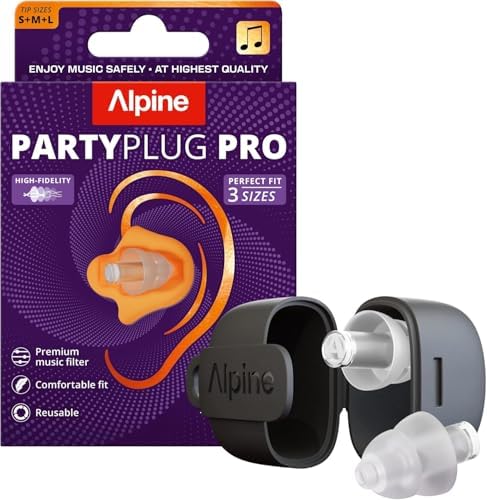
Alpine MusicSafe Pro — Best for Musicians and Multi-Venue Use
NRR: 16–22 dB (filter dependent) | Price: ~$40–$55
The Alpine MusicSafe Pro stands out for its interchangeable filter system. Three separate filters offer 16 dB, 19 dB, and 22 dB of attenuation. You swap filters before the show depending on venue size and expected volume. Small club? Use the 16 dB. Main stage at a festival? Go 22 dB.
The ThermoShape material warms to body temperature and adapts to your ear canal shape over time, which is a meaningful comfort advantage over standard silicone for extended wear. Hypoallergenic construction makes it a good call if you have sensitive skin reactions to standard silicone tips.
Bestseller #1

Bestseller #2
Loop Switch 2 — Best for Versatility
NRR: 12 dB (adjustable) | Price: ~$55–$65
The Loop Switch 2 adds an adjustable dial with three distinct modes: Quiet, Experience, and Engage. Quiet is near-full noise blocking. Experience is the concert mode — high-fidelity attenuation for full musical immersion. Engage opens the filter up for conversation and environmental awareness. The ability to switch modes without removing the earplug is genuinely useful at festivals where you move between stages, quiet areas, and conversations constantly.
Foam Earplugs vs. High-Fidelity Concert Earplugs: Which Is Better?
Let’s settle this directly. Foam earplugs provide excellent hearing protection — their NRR of 28–33 dB is more than sufficient to bring a loud concert to a safe exposure level. The problem is purely acoustic.
Standard foam creates an airtight physical seal that blocks sound uniformly only in theory. In practice, foam absorbs and attenuates high frequencies more aggressively than low frequencies. The result: the bass thumps through, the highs get swallowed. Instruments bleed into each other. Vocals lose intelligibility. You’re protected, but you’re not really hearing the concert.
High-fidelity concert earplugs sacrifice some peak protection (lower NRR) in exchange for even attenuation across all frequencies. For music lovers, this is always the right tradeoff. The only scenario where foam makes sense at a concert is if the show is so extremely loud — think front-row at a metal festival with 120 dB peaks — that maximum protection overrides the desire for musical fidelity.
Are Custom-Molded Concert Earplugs Worth It?
For most casual concertgoers — someone who attends 5–15 shows per year — a premium universal earplug like the Loop Experience 2 or Eargasm High Fidelity is more than sufficient. Custom-molded earplugs are a meaningful upgrade if:
- You attend concerts or music events more than once a week
- You are a performing musician who needs maximum comfort over long sets
- You have difficulty getting a proper seal from universal tips due to ear anatomy
- You want the absolute best combination of sound quality and long-term protection
Custom musicians’ earplugs, fitted by an audiologist, can range from $150 for basic models to over $400 for pro-grade options with interchangeable filters. Annual audiologist check-ins are also recommended for anyone with heavy noise exposure to establish a hearing baseline and verify that your protection is actually working.
How to Get the Best Performance From Your Concert Earplugs
Proper Insertion
- Wash hands before handling earplugs
- Pull the top of your outer ear upward and back to straighten the ear canal
- Insert the tip until it seats in the canal — you should feel a subtle pressure seal
- Check fit by cupping your hands over your ears: if the sound drops significantly, the seal is good
- If the earplug sits too shallow or feels loose, try the next size up
Care and Maintenance
- Rinse reusable silicone tips with warm water and mild soap after each use
- Allow to dry completely before storing — never seal damp earplugs in their case
- Do not use alcohol, bleach, or harsh solvents on the acoustic filter — this can damage the membrane
- Inspect the filter housing for debris before each use. A blocked filter does not attenuate evenly
- Replace tips when silicone becomes tacky, discolored, or loses its shape
Frequently Asked Questions About Concert Earplugs
What NRR should concert earplugs have?
For most concerts, an NRR between 12 and 22 dB is ideal. This range reduces volume to a safe level while preserving the sound quality of the performance. Remember to derate the stated NRR by approximately 50% for a realistic estimate of real-world protection — an NRR 20 earplug delivers roughly 10 dB of actual noise reduction in typical use conditions.
Can you still hear music clearly with concert earplugs?
Yes — with high-fidelity concert earplugs, the music sounds essentially the same, just quieter. The acoustic filter technology reduces all frequencies evenly, so you don’t lose bass, detail, or clarity. Many experienced concertgoers report that well-fitting concert earplugs actually improve the listening experience by reducing distortion and ear fatigue over long shows.
Are Loop earplugs the best concert earplugs?
Loop earplugs — particularly the Experience 2 and Switch 2 — are among the most popular and highly rated concert earplugs available. Lab testing consistently places them in the top tier for fit security and overall performance. However, for pure sound quality and attenuation flatness, the Eargasm High Fidelity and Etymotic ER20XS are strong competitors. The best concert earplugs for you depend on ear shape, preferred fit style, budget, and how much you value sound quality versus discretion.
Should I wear concert earplugs at every show?
If the show exceeds 85 dB — which virtually every amplified live music event does — then yes, concert earplugs are worth wearing every time. Even a single 2-hour concert at 105 dB without hearing protection represents a meaningful noise dose. Repeated exposure across a season of concerts accumulates risk that compounds over years.
How long do reusable concert earplugs last?
With proper care, most silicone high-fidelity concert earplugs last anywhere from 12 months to several years. The acoustic filter is typically the first component to degrade — you may notice the attenuation becoming less even or the perceived protection decreasing. When that happens, replacement filters or a new pair are in order.
Can children wear concert earplugs?
Yes, though children require purpose-built hearing protection designed for their smaller ear canals. Some brands include extra-small tips that may work for older children with adult-sized ears. For younger children or toddlers at concerts, over-ear ear defenders are generally more effective and easier to fit correctly than in-ear earplugs.
The Bottom Line on Concert Earplugs
| Bottom Line The best concert earplugs share three things: a high-fidelity acoustic filter for flat attenuation across all frequencies, a fit that actually seals your ear canal, and a comfortable design you will genuinely wear. Start with the Loop Experience 2 or Eargasm High Fidelity for most use cases. Step up to the Etymotic ER20XS if budget is tight, or the Alpine MusicSafe Pro if you need multi-level filter control. Spend the extra $20–$30 over foam. Your hearing will still be with you in 30 years. The ringing from the show that convinced you to finally buy concert earplugs will not be. |
Disclaimer: This article contains affiliate links. If you purchase through these links, I may earn a small commission at no additional cost to you
Digital Choice Hub — digitalchoicehub.com | Consumer Technology Reviews & Buyer’s Guides
Article last updated May 2026. Always consult a qualified audiologist for personalised hearing health advice.