
Best Garmin Watch 2026: Top Picks You Must See
Confused about which Garmin watch to buy in 2025? This detailed comparison breaks down Fenix 8, Venu 4, Forerunner, Instinct, and Enduro models to help you choose the perfect fit.

Garmin makes the best GPS sports watches in the world. They also make it frustratingly difficult to choose one.
Thank you for reading this post, don't forget to subscribe!In 2026, the lineup spans seven distinct product families, three display technologies, and a price range from $249 to nearly $2,800. The Fenix 8 and Fenix 8 Pro look almost identical at a glance but differ by $200 and a set of features that matter enormously to some buyers and not at all to others. The Venu 4 and Forerunner 570 cost exactly the same. The Instinct 3 Solar lasts longer than any smartwatch on the market. And if you’ve never heard of the Enduro 3, you may just be the person who needs it most.
This guide cuts through all of it. We cover Garmin’s seven most relevant 2025/2026 models with full feature breakdowns, honest pros and cons, head-to-head decision guides, and a clear recommendation for every type of buyer. Whether you are a first-time GPS watch buyer, a triathlete chasing a marathon PB, an ultrarunner who cannot afford a dead battery at mile 80, or an adventurer who ventures beyond mobile signal, the right Garmin exists for you — and this guide will tell you exactly which one it is.
Quick Answer
Best overall: Forerunner 570 ($549) — the best balance of training depth, everyday usability, and price for most athletes.
Best for beginners: Forerunner 165 ($249) — AMOLED, adaptive coaching, and 11-day battery at the most accessible price in the lineup.
Best for outdoor adventures: Fenix 8 (from $999) — full maps, dive-rated build, and Garmin’s complete feature set.
Best battery / ultrarunning: Enduro 3 ($899) — 320-hour solar GPS, the only watch that can outlast a 100-mile race.
Best for remote safety: Fenix 8 Pro (from $1,199) — phone-free satellite SOS and two-way messaging via inReach.
Need help deciding? Jump to ‘Which Garmin Should You Buy?’ below, or read each model in order.
Quick Navigation:
Fenix 8 | Fenix 8 Pro | Venu 4 | Forerunner 570 | Forerunner 165 | Instinct 3 Solar | Enduro 3 | Comparison Table | Which Should You Buy? | Garmin vs the Competition | 2026 Outlook | FAQ
Why Garmin Dominates the GPS Watch Market in 2026
Garmin (NYSE: GRMN) has spent more than 35 years building GPS and navigation hardware, originally for aviation and marine markets before pivoting aggressively into sports wearables. Today its Forerunner, Fenix, and Instinct lines are the gold standard for serious athletes and outdoor adventurers — a position built on three pillars that competitors consistently struggle to match simultaneously: GPS accuracy, battery life measured in days or weeks (not hours), and depth of training analytics developed in collaboration with sports physiologists.
The Garmin Connect ecosystem is the most comprehensive fitness cloud platform in the industry, with over 100 million registered users. In 2025 alone, Garmin introduced built-in LTE and satellite connectivity, MicroLED display technology, and a unified operating system (Garmin OS) across its flagship lines. The brand is system-agnostic — Garmin watches work equally well with iPhone and Android — which removes the ecosystem lock-in that limits Apple Watch and Samsung Galaxy Watch to their respective platforms.
Quick Comparison: 7 Best Garmin Watches 2026 at a Glance
| Watch | Best For | Price (USD) | Smartwatch Battery | GPS Battery | Maps | Display |
| Fenix 8 | Premium multisport | From $999 | Up to 29 days | Up to 90 hrs | Yes | AMOLED or Solar MIP |
| Fenix 8 Pro | Remote / satellite safety | From $1,199 | Up to 27 days | Up to 90 hrs | Yes | AMOLED or MicroLED |
| Venu 4 | Lifestyle + fitness | $549 | Up to 14 days | 18 hrs | No | AMOLED |
| Forerunner 570 | Runners & triathletes | $549 | Up to 11 days | 18 hrs | No | AMOLED |
| Forerunner 165 | Beginners / value | $249 / $299 | Up to 11 days | 19 hrs | No | AMOLED |
| Instinct 3 Solar | Rugged outdoor durability | From $399 | 28–40 days (solar) | 130 hrs (solar) | No | MIP Solar |
| Enduro 3 | Ultra-endurance / thru-hike | $899 | Up to 36 days | 320 hrs (solar) | Yes | MIP Solar |
Best Garmin Watches 2026: Quick Picks by Use Case
| Use Case | Best Watch | Why |
| Best overall | Forerunner 570 | Training depth + usability + price — the ideal balance for most athletes |
| Best for beginners | Forerunner 165 | AMOLED, Garmin Coach plans, and an 11-day battery at just $249 |
| Best for trail / adventure | Fenix 8 | Full TopoActive maps, dive rating, AMOLED or solar display choice |
| Best for ultrarunning | Enduro 3 | 320-hour solar GPS — the only watch that can outlast a 100-mile race |
| Best battery life | Instinct 3 Solar | Effectively unlimited in smartwatch mode with regular sunlight |
| Best for remote safety | Fenix 8 Pro | Phone-free satellite SOS and two-way messaging via inReach |
| Best lifestyle / office | Venu 4 | Full metal case, ECG, and 14-day battery in a premium everyday design |
| Best value | Forerunner 165 | Punches well above its $249 price — AMOLED and training tools at entry level |
01 | Garmin Fenix 8
Price: From $999 Sizes: 43mm, 47mm, 51mm Display: AMOLED or MIP Solar
Best for: Trail runners, triathletes, mountaineers, cyclists, and divers who want Garmin’s full premium feature set without paying for satellite connectivity they may never use.
Overview
The Garmin Fenix 8 is the direct convergence of Garmin’s formerly separate Fenix and Epix lines into one unified premium adventure platform. Launched in summer 2024 and refined through extensive firmware updates in 2025, it is the benchmark against which every other multisport GPS watch is measured. If you want Garmin’s best experience — full TopoActive maps, dive-rated construction, AMOLED display, deep analytics — without the added cost of satellite messaging, the Fenix 8 is the definitive choice for the majority of serious athletes and adventurers.
What makes the Fenix 8 genuinely unique at this price point is its display flexibility. No other premium GPS watch lets you choose between a vivid AMOLED screen and a solar-charging MIP display at the same spec level. Choose AMOLED for daily training and race day. Choose MIP Solar for expedition-length adventures where charging is impractical.
Key Features
- Build & durability: Dive-rated construction, leakproof metal buttons, titanium bezel, metal sensor guard cover, built-in LED flashlight, MIL-STD-810-inspired toughness
- Display choice: AMOLED (vivid, high-resolution) or MIP Solar (dramatically longer battery plus passive solar charging) — unique flexibility in the premium segment
- GPS & navigation: Preloaded multi-continent TopoActive maps, multi-band dual-frequency GNSS, SatIQ technology, dynamic round-trip routing, ClimbPro climb profiling, breadcrumb and turn-by-turn navigation
- Training analytics: Training Readiness, Training Status, VO2 Max, Body Battery, HRV Status, Endurance Score, Hill Score, Daily Suggested Workouts, sleep coaching, Garmin ECG App, Garmin Triathlon Coach
- Smart features: Built-in speaker and microphone for Bluetooth calls, Spotify/Deezer/Amazon Music offline storage, Garmin Pay, fast Garmin OS firmware updates
- Battery: AMOLED version up to 29 days smartwatch mode, up to 90 hours GPS; MIP Solar extends further with sunlight
Pros and Cons
| Pros | Cons |
| Unique AMOLED or MIP Solar display choice | No LTE or satellite messaging |
| Full TopoActive maps on-wrist | 43mm size not available on Fenix 8 Pro (upgrade path limits) |
| Dive-rated with ECG App and flashlight | Heavier than Enduro 3 (~97g for 47mm AMOLED) |
| Complete Garmin training analytics suite | From $999 — the premium price reflects the premium spec |
| Huge size range: 43mm, 47mm, 51mm | AMOLED battery significantly shorter than Enduro 3 or Instinct |
Verdict
The Fenix 8 is the right choice for the vast majority of serious athletes and adventurers who want everything Garmin offers in one watch. It is the most versatile watch in the lineup. Only look elsewhere if you specifically need satellite communication (→ Fenix 8 Pro) or want maximum battery life at lower weight and price (→ Enduro 3).

- Advanced multisport GPS smartwatch for athletes/adventurers features a bright 1.4” AMOLED display, stainless steel bezel…
- Power up your body’s performance, endurance and resistance to injury with targeted strength training plans, real-time st…
- Battery performance: up to 16 days in smartwatch mode; up to 47 hours in GPS mode. Fits wrists with the following circum…
$699.99
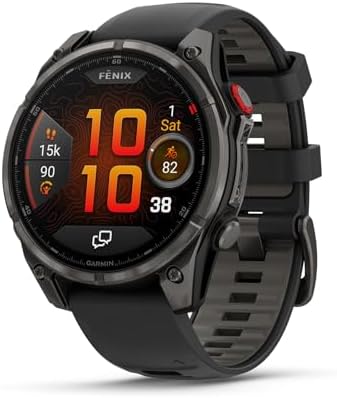
02 | Garmin Fenix 8 Pro
Price: From $1,199 (AMOLED) | $1,999–$2,799 (MicroLED) Sizes: 47mm, 51mm Display: AMOLED or MicroLED
Best for: Solo adventurers, backcountry explorers, ultra-athletes, and anyone who regularly leaves phone signal behind and needs phone-free SOS, two-way messaging, and location sharing.
Overview
Launched September 3, 2025, the Fenix 8 Pro is Garmin’s most technologically ambitious watch to date. It inherits every feature from the Fenix 8 and adds two genuinely transformative capabilities: built-in LTE-M and two-way satellite messaging via Garmin inReach technology, and a brand-new MicroLED display option for the 51mm variant — at 4,500 nits of peak brightness, the most luminous display ever fitted to a smartwatch.
For most buyers in cellular range, the standard Fenix 8 offers identical training and navigation capability at $200 less. But for anyone who ventures into the backcountry, remote mountains, or open ocean, the Fenix 8 Pro is not just a GPS watch — it is a safety device.
Key Features
- LTE + Satellite: Send and receive texts, share LiveTrack location, make voice calls, exchange 30-second voice messages, and trigger an interactive SOS to Garmin’s 24/7 Response Centre (200+ languages) — all without a phone. Requires Skylo satellite network and active inReach subscription from $7.99/month
- MicroLED display (51mm only): 4,500 nits peak brightness — more than double a standard AMOLED. Exceptional in direct sunlight, snow glare, and on-wrist map reading. Trade-off: up to 10 days smartwatch battery vs 27 days for AMOLED
- AMOLED models (47mm and 51mm): ~2,000 nits brightness — a meaningful upgrade over the standard Fenix 8 — while retaining 27-day smartwatch battery life. The optimal balance for most buyers
- New running metrics: Running Economy, Running Tolerance, and Step Speed Loss — borrowed from the Forerunner 970
- Everything from Fenix 8 plus: Louder speakers, sapphire lens standard, titanium bezel
- Satellite messaging requires specific wrist orientation toward the satellite — a practical compromise versus a dedicated inReach device
Fenix 8 Pro vs Fenix 8 — Which Should You Choose?
| Feature | Fenix 8 | Fenix 8 Pro |
| LTE messaging | No | Yes |
| Satellite SOS | No | Yes (inReach) |
| MicroLED option | No | Yes (51mm only) |
| 43mm size | Yes | No |
| Battery (AMOLED smartwatch) | Up to 29 days | Up to 27 days |
| Running Economy metric | No | Yes |
| Price (from) | $999 | $1,199 |
Verdict
The Fenix 8 Pro’s satellite and LTE features only justify the ~$200 premium if you genuinely adventure in areas without phone signal. If you run roads, race triathlons in urban environments, or stay within cellular range, the standard Fenix 8 delivers identical training and navigation for less. But for solo mountaineers, backcountry trail runners, offshore sailors, and wilderness adventurers, the Fenix 8 Pro may be the most important safety device on the market.
- Multisport GPS smartwatch with built-in inReach technology for two-way satellite and LTE connectivity (active subscripti…
- Rugged design with a bright 1.4″ AMOLED touchscreen display, titanium bezel, scratch-resistant sapphire lens and other p…
- In an emergency, inReach satellite technology allows you to trigger an interactive SOS message to the Garmin ResponseSM …
$1,099.99
03 | Garmin Venu 4
Price: $549 Sizes: 41mm, 45mm Display: AMOLED Released: September 2025
Best for: Fitness-focused professionals, Apple Watch switchers who want superior battery life, and anyone who wants Garmin’s deepest health analytics in an office-appropriate, premium-looking design.
Overview
The Venu 4 is Garmin’s most refined lifestyle-first smartwatch. It bridges the gap between Garmin’s sport-focused lineup and the everyday appeal of an Apple Watch or Samsung Galaxy Watch — while maintaining the training depth and multi-week battery life that sets Garmin apart. The key upgrades over the Venu 3 are substantial: the first full metal case in the Venu line (stainless steel), multi-band dual-frequency GNSS, ECG App, LED flashlight, and expanded health features including Lifestyle Logging — a new tool that correlates caffeine intake, meals, and sleep patterns with your HRV and Body Battery.
At $549, the Venu 4 shares the exact same price as the Forerunner 570 and carries near-identical training features. The decision between them comes down entirely to design philosophy: lifestyle versatility versus sport-first operation.
Key Features
- Premium design: First Venu with a full metal case (stainless steel), available in 41mm and 45mm with multiple colour options — transitions naturally from gym to office to evening out
- Training depth: Training Readiness, Training Status, Load Ratio, projected race time predictor, heat and altitude acclimation, HRV Status, Daily Suggested Workouts, Garmin Triathlon Coach — feature parity with Forerunner 570
- GPS accuracy: Multi-band dual-frequency GNSS with SatIQ — on par with the Fenix 8 Pro in urban canyon testing
- Health features: ECG App, Health Status overnight biometric monitor, Lifestyle Logging (caffeine, meals, sleep patterns), Sleep Alignment and Consistency scoring, Body Battery, stress tracking
- Smart features: On-wrist speaker and microphone for Bluetooth calls, Garmin Pay, offline music (Spotify, Deezer, Amazon Music), 80+ sports profiles, LED flashlight
- Battery: Up to 14 days smartwatch mode, 18 hours GPS active
Venu 4 vs Forerunner 570 — How to Choose
| Factor | Venu 4 | Forerunner 570 |
| Design priority | Lifestyle / office-appropriate | Sport-first / athletic |
| Primary controls | Touchscreen (2 buttons) | 5 physical buttons + touchscreen |
| ECG App | Yes | No |
| Case material | Full metal (premium feel) | Aluminium bezel / polymer back |
| Battery life | Up to 14 days | Up to 11 days |
| Best context | Daily wear → gym → office | Training runs → races → gym |
Verdict
The Venu 4 is the best Garmin for people who want to look good at work and train seriously after hours. Its full metal case, ECG capability, and 14-day battery edge it ahead of the Forerunner 570 for everyday carry. If you race frequently and prefer tactile button control mid-run, the Forerunner 570 wins. If aesthetics and daily wearability come first, the Venu 4 is the pick at the $549 price point.

- Smartwatch with a bright, colorful display, stainless steel design, and built-in flashlight; up to 12 days of battery li…
- Make improvements to promote a healthier lifestyle and know your body better with extensive health monitoring features, …
- Get a sleep score and personalized sleep coaching, including recommendations for how much sleep you need, tips on how to…
$549.99
04 | Garmin Forerunner 570
Price: $549 Sizes: 42mm, 47mm Display: AMOLED Released: May 2025
Best for: Dedicated runners, triathletes, and multi-sport athletes who train with structured plans, compete in road races, and prefer five-button tactile operation for reliable in-race control.
Overview
Launched May 2025, the Forerunner 570 succeeds the widely praised Forerunner 265. It adds an aluminium bezel, a brighter AMOLED display across two sizes, a built-in speaker and microphone, the new Elevate Gen 5 heart rate sensor, and additional training tools. It remains Garmin’s mid-tier running and triathlon specialist — feature-rich, sport-focused, and more reliably operable mid-race than any touchscreen-centric watch thanks to its five-button layout.
The five physical buttons are a genuine competitive advantage in wet conditions, heavy gloves, or the final miles of a race when fine motor control is degraded. This is the detail that separates the Forerunner 570 from the Venu 4 for competitive athletes — and it matters more than most marketing comparisons acknowledge.
Key Features
- Design: Vibrant two-tone colour options (Raspberry/Mango, Amp Yellow, Indigo), aluminium bezel upgrade, Corning Gorilla Glass 3, available in 42mm and 47mm
- Training analytics: Full running suite — Training Readiness, Training Status, Daily Suggested Workouts, Acute Load, VO2 Max, wrist-based running power, running dynamics, Garmin Triathlon Coach, structured multisport workouts, projected race time predictor, AutoLap
- Heart rate: Elevate Gen 5 sensor with improved accuracy in cold weather and during downhill running; adds nightly skin temperature readings
- Smart features: Built-in speaker/microphone for Bluetooth calls, Siri/Google Assistant, music storage, Garmin Pay, incident detection with LiveTrack
- Battery: Up to 11 days smartwatch, 18 hours GPS
- Notable omissions: No onboard maps (breadcrumb navigation only), no ECG App, no flashlight, 8GB storage vs 32GB on Forerunner 970
Pros and Cons
| Pros | Cons |
| 5-button layout — reliable in any condition | No onboard maps at $549 — Venu 4 and Enduro 3 both offer more |
| Elevate Gen 5 HR sensor — most accurate Garmin has offered | No ECG App (Venu 4 has this at the same price) |
| Two sizes (42mm, 47mm) with bold colour choices | 11-day battery vs 14 days on Venu 4 |
| Complete Garmin triathlon coaching toolkit | Lighter aluminium bezel feels less premium than Venu 4’s full metal |
Verdict
The Forerunner 570 is the choice for anyone who runs 30–50+ miles per week, follows structured training plans, and competes in road races or triathlons. The five-button layout is a genuine advantage in wet conditions, gloves, or mid-race fatigue. The omission of onboard maps at $549 is the only significant complaint — if navigation matters, step up to the Enduro 3 or Fenix 8 instead.

- Our brightest AMOLED touchscreen display with button controls and an aluminum bezel in 42 mm size to fit smaller wrists
- Up to 10 days of battery life in smartwatch mode and up to 18 hours in GPS mode for a more complete picture of your trai…
- Train for an event, achieve a milestone, or improve your fitness with Garmin Coach training plans; these running and tri…
$549.99
05 | Garmin Forerunner 165
Price: $249 (standard) | $299 (Music edition) Size: 43mm Display: AMOLED
Best for: Beginner to intermediate runners, first-time GPS watch buyers, and anyone wanting Garmin’s trusted ecosystem at the most accessible price point in the lineup.
Overview
The Forerunner 165 launched in early 2024 and quickly became one of Garmin’s best-selling watches ever. It brought an AMOLED touchscreen and a genuinely generous feature set down to Garmin’s most accessible Forerunner price point — and two years later, it remains the best value watch in the lineup. No successor has launched as of April 2026, making it even more important to buy the Music edition if offline playlists matter to you.
At just 39 grams with a resin case and soft silicone band, it is one of the most comfortable 24/7 wearables in Garmin’s entire range — a real advantage for first-time GPS watch wearers who aren’t yet used to sleeping and showering in a watch.
Key Features
- Display: 1.2-inch AMOLED touchscreen with 390 x 390 resolution — vivid and a generational leap over the MIP displays in older entry-level Garmin models
- Training: Daily Suggested Workouts (personalised and adaptive), Garmin Coach plans for 5K, 10K, and half marathon, VO2 Max, Body Battery, stress tracking, sleep scoring, menstrual cycle tracking, 25+ activity profiles, morning report
- GPS: Single-band (not dual-frequency) — solid accuracy for road and trail running; within hundredths of a mile on known routes in testing. Not as precise as multi-band models in dense urban canyons
- Health: Elevate Gen 4 optical heart rate, HRV Status, SpO2, nap detection, women’s health tracking
- Smart: Notifications, Garmin Pay, incident detection, LiveTrack
- Weight: Only 39 grams — one of the lightest GPS watches in the category
- Battery: Up to 11 days smartwatch, 19 hours GPS
- Key omissions vs Forerunner 570: No dual-band GNSS, no Training Readiness, no maps, no speaker/microphone, no ECG App
Who Should Buy the Music Edition?
The Music edition ($299) adds 4GB of offline storage for Spotify, Deezer, and Amazon Music playlists and adds a $50 premium. If you run without your phone or want music without carrying a device, it is well worth it. If you always run with your phone and stream, the standard edition saves you $50.
Verdict
At $249, the Forerunner 165 delivers exceptional value. For anyone new to GPS running watches, training for their first 5K or half marathon, or wanting a reliable entry into the Garmin ecosystem without a significant investment, it is the clear recommendation. Rivals like the Coros Pace 4 have narrowed the competitive gap in 2025, but for Garmin ecosystem buyers, the 165 remains the strongest starting point in the lineup.

- Easy-to-use running smartwatch with built-in GPS for pace/distance and wrist-based heart rate; brilliant AMOLED touchscr…
- Up to 11 days of battery life in smartwatch mode and up to 19 hours in GPS mode
- Reach your goals with personalized daily suggested workouts that adapt based on performance and recovery; use Garmin Coa…
$249.99
06 | Garmin Instinct 3 Solar
Price: From $399 (45mm) | From $449 (50mm) Sizes: 45mm, 50mm Display: MIP Solar (monochrome) Released: January 2025
Best for: Outdoor adventurers, hikers, hunters, military professionals, and anyone who needs a rugged, near-indestructible GPS watch with exceptional battery life at a sub-Fenix price.
Overview
The Garmin Instinct 3 Solar is the toughest watch in the Garmin lineup that doesn’t carry a Fenix price tag. Launched January 2025, it is built around a simple premise: some environments demand a watch that prioritises survivability over elegance. The MIP Solar display is monochrome and modest compared to the AMOLED screens on the Venu 4 or Forerunner 570 — but it is also always-on, readable in any lighting condition including direct equatorial sunlight, and powered indefinitely by the solar panel embedded in the dial.
In unlimited activity mode with sufficient solar exposure, the Instinct 3 Solar’s battery is effectively infinite. For most real-world users running 10–12 hours of GPS activity per week in outdoor conditions, recharging is a once-a-month event or less. This is the watch that disappears on your wrist and keeps going regardless of what you do to it.
Key Features
- Durability: MIL-STD-810 certified for thermal, shock, and humidity resistance; 100m water resistance; reinforced case architecture designed to withstand drops and impacts that would crack a premium smartwatch
- Display: Monochrome MIP Solar with embedded solar charging lens — always-on, always readable, no screen-tap required to check the time or stats
- Battery: Up to 40 days smartwatch mode with solar (28 days without); up to 130 hours GPS mode with solar; solar charging adds meaningful runtime in direct sunlight at the expense of the AMOLED visuals found on higher-end models
- GPS and navigation: Multi-band dual-frequency GNSS, breadcrumb trail navigation, bearing tracking, ABC sensors (altimeter, barometer, compass), storm alert, sunrise/sunset times
- Training analytics: Activity tracking for running, cycling, swimming, hiking, and more; VO2 Max; Body Battery; stress tracking; Health Snapshot; sleep monitoring — not as deep as Fenix 8, but comprehensive for the price
- Outdoor tools: Stealth mode (disables all wireless transmissions for hunting and security), kill switch, night vision goggle compatibility, dual-format GPS coordinates display
- Smart features: Smart notifications (view only, no reply), Garmin Pay, Connect IQ apps; notably no speaker or microphone
- Weight: 45mm weighs approximately 53g — significantly lighter than the Fenix 8
Instinct 3 Solar vs Fenix 8 — How to Choose
| Factor | Instinct 3 Solar | Fenix 8 |
| Display | Monochrome MIP Solar (always-on) | AMOLED or MIP Solar (colour) |
| Battery (smartwatch) | Up to 40 days solar | Up to 29 days (AMOLED) |
| Maps | No (breadcrumb only) | Yes (full TopoActive) |
| Price | From $399 | From $999 |
| Weight | ~53g (45mm) | ~97g (47mm AMOLED) |
| Best for | Tactical / outdoor / budget rugged | Premium multisport + maps + training |
Pros and Cons
| Pros | Cons |
| Effectively unlimited battery with regular sunlight | Monochrome display — no colour maps, no AMOLED |
| MIL-STD-810 toughness — genuinely indestructible daily use | No onboard maps (breadcrumb only) |
| Multi-band GNSS — Fenix-level GPS accuracy | No speaker/microphone, no Bluetooth calls |
| From $399 — far below Fenix pricing | Training analytics less deep than Fenix 8 |
| Stealth mode and tactical outdoor tools | Touchscreen removed in favour of 5-button-only — harder to navigate menus |
Verdict
The Instinct 3 Solar is the watch for anyone who prioritises absolute durability and near-infinite battery life over display quality and map depth. It occupies a distinct niche: too rugged and battery-focused for the everyday fitness crowd (they’d choose the Forerunner 165 or Venu 4), but far more affordable than the Fenix 8 for users who need MIL-spec toughness. If your watch needs to survive everything you can throw at it and charge itself in the process, the Instinct 3 Solar is the clear answer.

- Make a bold statement with this rugged GPS smartwatch, featuring a 1.1” display with solar charging lens and unlimited b…
- Engineered with a supertough 50 mm fiber-reinforced polymer case and metal-reinforced bezel
- Built-in LED flashlight with variable intensities and strobe modes gives you greater visibility in the outdoors and prov…
$446.95
07 | Garmin Enduro 3
Price: $899 Size: 51mm Display: MIP Solar
Best for: Ultramarathon runners, thru-hikers, multi-day adventure racers, and expedition athletes for whom battery failure mid-race or mid-expedition is simply not an option.
Overview
The Garmin Enduro 3 exists to answer a single question that no other watch in the lineup answers adequately: what if you need more than 90 hours of GPS navigation? With up to 320 hours of GPS battery in solar mode — that is more than 13 days of continuous GPS tracking — the Enduro 3 is the only consumer GPS watch on the market capable of navigating a multi-week thru-hike or a 200-mile ultramarathon from start to finish without recharging.
It is not the watch for everyday use. The 51mm case, MIP Solar (monochrome) display, and $899 price tag all reflect a singular design philosophy: when battery life matters more than anything else, compromise everything else for it. But paired with full TopoActive maps, a titanium bezel, and the complete Garmin training analytics suite, the Enduro 3 is arguably the most capable watch Garmin makes for the specific athlete it targets.
Key Features
- Battery: Up to 36 days smartwatch mode; up to 320 hours GPS with solar; up to 90 hours GPS without solar — the longest GPS endurance of any consumer watch on the market
- Solar charging: Power Glass solar lens integrated into the display; significant runtime extension in direct sunlight — critical for multi-day and multi-week expeditions where charging infrastructure is unavailable
- Navigation: Full preloaded TopoActive maps (same as Fenix 8), multi-band dual-frequency GNSS with SatIQ, ClimbPro profiling, dynamic round-trip routing, breadcrumb and turn-by-turn navigation
- Build: Titanium bezel, carbon fibre reinforced polymer case, MIL-STD-810 toughness, 100m water resistance — lighter than the Fenix 8 AMOLED despite equivalent protection
- Training analytics: Full Garmin endurance suite — Training Readiness, Training Status, VO2 Max, Endurance Score, Hill Score, HRV Status, Body Battery, Daily Suggested Workouts, Garmin Triathlon Coach, wrist-based running power, running dynamics
- Weight: 63g — substantially lighter than the Fenix 8 47mm AMOLED (97g), which matters acutely at 100+ mile race distances
- Smart features: Garmin Pay, offline music storage, smart notifications, incident detection with LiveTrack — no built-in speaker or microphone
Enduro 3 vs Fenix 8 — How to Choose
| Factor | Enduro 3 | Fenix 8 (AMOLED) |
| GPS battery | 320 hours (solar) | 90 hours |
| Smartwatch battery | Up to 36 days | Up to 29 days |
| Display | MIP Solar (monochrome) | AMOLED or MIP Solar (colour) |
| Maps | Yes (full TopoActive) | Yes (full TopoActive) |
| Weight | 63g | ~97g (AMOLED) |
| Price | $899 | From $999 |
| Speaker/mic | No | Yes |
| Best for | Ultra-endurance, expeditions | Multisport, triathlon, everyday premium |
Pros and Cons
| Pros | Cons |
| 320-hour solar GPS — unmatched in the category | Monochrome MIP display — no AMOLED option |
| Full maps at $899 — $100 less than Fenix 8 | 51mm only — no smaller size option |
| 63g — meaningfully lighter than Fenix 8 AMOLED | No speaker or microphone |
| Complete training analytics suite — nothing stripped | Overkill for casual athletes who charge weekly anyway |
Verdict
If you are running 100-mile ultras, completing multi-week thru-hikes, or racing expedition-length adventure races, the Enduro 3 is the only rational choice in the Garmin lineup — or anywhere on the market. Its 320-hour solar GPS battery and full TopoActive maps in a 63g case represent a unique combination that no competitor has matched. For everyone else who charges their watch weekly, the Fenix 8 offers a more versatile daily experience at a comparable price.

- Designed for ultra-endurance athletes, with a lightweight design weighing just 63 g to help improve performance
- Take on the elements with a titanium bezel, scratch-resistant sapphire lens and built-in LED flashlight to light up the …
- Up to 90 days of battery life in smartwatch mode (assumes all-day wear with 3 hours per day outside in 50,000 lux condit…
$899.99
Which Garmin Watch Should You Buy?
Use the decision guide below to find your match based on your primary activity, budget, and the features you actually need.
| Your situation | Best watch | Why |
| New to GPS watches, budget under $300 | Forerunner 165 | AMOLED, adaptive training, and 11-day battery — best value in the category |
| Serious runner / triathlete, $549 budget | Forerunner 570 | Complete Garmin training suite, five-button control, two sizes |
| Want premium design, train and go to work | Venu 4 | Full metal case, ECG, same training depth as FR570 |
| Trail running, cycling, hiking, $999+ budget | Fenix 8 | Full maps, dive rating, display choice, best versatility |
| Venture beyond mobile signal regularly | Fenix 8 Pro | Satellite SOS and two-way messaging are literal safety tools |
| Need maximum ruggedness on a budget | Instinct 3 Solar | MIL-spec toughness, multi-band GPS, near-infinite battery from $399 |
| Ultramarathon runner or thru-hiker | Enduro 3 | 320-hour GPS battery and full maps — nothing else comes close |
Garmin vs the Competition in 2026
Garmin does not operate in a vacuum. Here is how the lineup compares to the three most credible alternatives.
Garmin vs Apple Watch
Apple Watch Series 10 and Apple Watch Ultra 2 are the most direct competitors for the premium and everyday segments. Apple Watch wins on smartphone integration (iPhone users get deeper Siri, iMessage, and app ecosystem access), third-party app depth, and for casual users who primarily want a lifestyle device with fitness tracking as a secondary function. Garmin wins decisively on battery life (days and weeks vs 18–36 hours), GPS accuracy, training analytics depth, and durability. Many serious athletes own both: an Apple Watch for daily life and a Garmin for training. If you are choosing one device and sport is the priority, Garmin.
Garmin vs Coros
Coros has emerged as the most credible challenger in the endurance sports segment. The Coros Pace 4 ($229) and Vertix 2S ($699) undercut Garmin on price while matching multi-band GPS accuracy and offering competitive battery life. Coros’s training load model has earned respect from elite athletes and coaches. Where Garmin still leads: the depth of the Connect ecosystem, breadth of supported sports, smartwatch features (calls, music, payments), and the breadth of health metrics (ECG, HRV, Body Battery). For pure running performance at a lower price, Coros is a serious consideration. For the full wearable experience, Garmin maintains the edge.

- Uncompromisingly light and durable: The 6000‑series aluminum alloy bezel provides a high‑integrity frame, yet PACE 4 Bla…
- AMOLED AT ITS BEST: The touchscreen AMOLED display has a tapered edge, crystal clear visibility, and vibrant colors. It …
- BIG BATTERY LIFE: Train longer without interruption. With 41 hours of continuous GPS use and up to 19 days of daily batt…
$299.00
Garmin vs Polar
Polar’s Grit X2 Pro and Vantage V3 target the same triathlon and endurance audience as the Fenix 8 and Forerunner 570. Polar’s training load and recovery analytics are excellent — arguably more nuanced than Garmin’s in specific contexts — and the build quality is strong. Garmin’s advantages: a vastly larger Connect community, superior map support, longer battery life across most models, and a more complete smartwatch feature set. Polar is a legitimate alternative for data-focused triathletes, but Garmin’s ecosystem breadth makes it the default recommendation for most buyers.
What to Expect from Garmin in 2026
2025 was Garmin’s busiest product year in wearables history. 2026 is expected to be more selective — but no less significant.
Garmin Fenix 9 — Summer 2026
The Fenix 9 is the most widely anticipated Garmin release of 2026. Garmin has refreshed its flagship adventure line annually, and a summer 2026 launch is consistent with that pattern. Expected improvements include further MicroLED availability, expanded satellite connectivity options, updated health sensors, and refinements to Garmin OS. If you are considering a Fenix 8 and can wait, monitoring Garmin’s announcements in Q2 2026 is worth doing.
Entry-Level Forerunner Refresh
The Forerunner 55 is approaching four years old and the Forerunner 165 is closing in on its second birthday. Both are still strong watches, but a refresh at the entry-level end of the Forerunner line is overdue. If you are shopping at the $200–$300 price point, a new model in H1 2026 is plausible — though the Forerunner 165 remains excellent value even if it is superseded.
Garmin CEO’s Commitment
Garmin’s CEO Cliff Pemble has publicly signalled ‘a significant number of new product introductions’ in the outdoor segment for the back half of 2026. The specifics remain unannounced, but the statement confirms that the current lineup — strong as it is — will be meaningfully extended before year end.
Frequently Asked Questions
Which is the best Garmin watch in 2026?
The Garmin Forerunner 570 is the best Garmin watch for most people in 2026. It delivers every training metric a serious runner or triathlete needs — Training Readiness, VO2 Max, wrist-based running power, structured plans, and triathlon coaching — at $549, without the Fenix 8’s weight or price premium. For premium multisport adventures with full maps, the Fenix 8 is the benchmark. For pure endurance events lasting days, the Enduro 3.
What is the difference between the Garmin Fenix 8 and Fenix 8 Pro?
The Fenix 8 Pro adds three capabilities not found on the standard Fenix 8: built-in LTE-M cellular for voice calls and messaging, two-way satellite messaging via Garmin inReach technology for communication without phone signal, and a MicroLED display option (51mm only) with 4,500 nits of peak brightness. The Pro also adds new running metrics — Running Economy, Running Tolerance, and Step Speed Loss. The standard Fenix 8 offers identical training, navigation, and dive-rated hardware for $200 less. The Pro is only worth the upgrade if you genuinely venture beyond cellular coverage.
Is Garmin worth buying in 2026?
Yes — for athletes who train seriously, Garmin watches offer GPS accuracy, battery life, and training analytics that no competitor matches simultaneously in a single package. Apple Watch is stronger for smartphone integration and third-party apps; Coros offers longer battery at lower prices for running; but for the full combination of performance, durability, smartwatch features, and ecosystem depth, Garmin remains the category leader in 2026.
Does Garmin work with iPhone?
Yes. All Garmin watches are fully compatible with iPhone via the free Garmin Connect app (iOS 16 or later, available on the App Store). You can receive notifications, sync activities, access Garmin Coach training plans, and use Garmin Pay on supported models. Note: iPhone users can view message notifications on the watch but cannot reply directly — Android users have full reply capability. Garmin’s system-agnostic design is a key advantage over Apple Watch and Samsung Galaxy Watch.
Which Garmin watch has the best battery life?
The Garmin Enduro 3 has the longest battery life of any Garmin watch — up to 320 hours in GPS mode with solar, and 36 days in smartwatch mode. The Instinct 3 Solar offers up to 130 hours of GPS with solar and runs indefinitely in smartwatch mode with adequate sunlight exposure. For AMOLED watches, the Fenix 8 leads with up to 29 days in smartwatch mode and 90 hours GPS.
What new Garmin watches are coming in 2026?
The Garmin Fenix 9 is widely expected to launch in summer 2026, continuing the annual flagship refresh cycle. Entry-level Forerunner models (successors to the Forerunner 55 and possibly the 165) are anticipated in H1 2026. Garmin’s CEO has confirmed additional product introductions in the outdoor segment for the back half of 2026. The Instinct, Venu, and Vivoactive lines are unlikely to see major refreshes, having all been updated in 2025.
How does Garmin Connect compare to Apple Health and Google Fit?
Garmin Connect is the most comprehensive fitness-specific platform among the three. It stores the most granular training data — GPS tracks, advanced running dynamics, HRV trends, sleep staging, Body Battery history — and supports deeper analytical tools like Training Load Ratio and Endurance Score. Apple Health and Google Fit are broader health aggregators designed to collect data from many apps and devices; they are not purpose-built training platforms. Garmin Connect is the ecosystem’s greatest strength for serious athletes.
Is Garmin better than Apple Watch for running?
For running specifically, yes — Garmin is better than Apple Watch for most serious runners. Garmin’s multi-band GPS is more accurate in challenging environments, battery life is measured in days rather than hours, and training analytics (running dynamics, Running Power, Training Readiness, race predictors) go significantly deeper. Apple Watch has advantages in general smartwatch experience, Apple ecosystem integration, and for casual exercisers who prioritise lifestyle features. Runners training for road marathons or ultras will find Garmin’s feature set more aligned with their needs.
Price note: All prices are approximate USD RRPs as of April 2026. Battery life figures are Garmin’s official claims under controlled conditions; real-world performance varies based on settings, activities, temperature, and individual usage patterns. Always verify current pricing and availability with retailers.
Think waterproof is all that matters? Discover the real features that separate basic watches from true swim-ready performance in this guide: 👉 Swim Watch Features Beyond Waterproof
Disclaimer: This article contains affiliate links. If you purchase through these links, I may earn a small commission at no additional cost to you
All prices are approximate USD RRPs as of April 2026. Battery life figures are Garmin’s official claims under controlled conditions; real-world performance may vary based on settings, activities, temperature, and individual usage patterns. Always verify current pricing and availability with retailers.
© 2026 DigitalChoiceHub.com — All rights reserved.
